
Fighting a “Hyper-scale” Data Center Campus in the Hinterlands Produces a Win.

What We All Need to Know: Citizen Action Counts.
Back in October last year, I posted “Old Age: New Battles,” https://jcaverleyhamilton.substack.com/p/old-age-new-battles. The battle involved just one of the oligarchs’ many efforts to impose data center “campuses” on the rest of us. In this case the effort involved an attempted rezoning of more than 1000 acres of prime farm acreage in Northern Indiana from agricultural to industrial. The details appear in the introduction to “Old Age: New Battles.”
After the people persuaded the St. Joseph Area Plan Commission to reject the proposed rezoning 7 - 0, the County Council kicked the can down the road, past a couple of Committee meetings, and past its next regular meeting on October 14, 2025. The October 14 meeting was the setting for “Old Age: New Battles.”
The battle continued on October 28 as a committee of the Council listened to a two hour pitch by the zoning proponent (the actual principal never identified). While the public could not speak during this committee meeting they attended in large numbers, “NO DATA CENTERS” signs in hand. At the end of it all, the Committee recommended against the rezoning 3 - 2, another battle won for the moment.
The mystery proponent now went dark; now burdened by two negative interim decisions, it withdrew its application from the Council’s next regular meeting, on November 12 (when the public could have registered its opposition to the petition during the hearing). However, once again, privilege of the floor allowed the public to speak, three minutes each, on any subject not formally within the Council’s agenda. About 15 of us exercised that privilege. Once again, I emailed the Council members this annotated version of my three minutes of talk:
The Oligarchs Are Not Our Friends
As we contemplate sacrificing another 1000 acres and more of prime farmland to yet another “hyper-scale” data center campus -- the newest form of industrialization -- I suggest we concentrate on the big picture. Who actually will benefit from what our County decides to do on this issue?
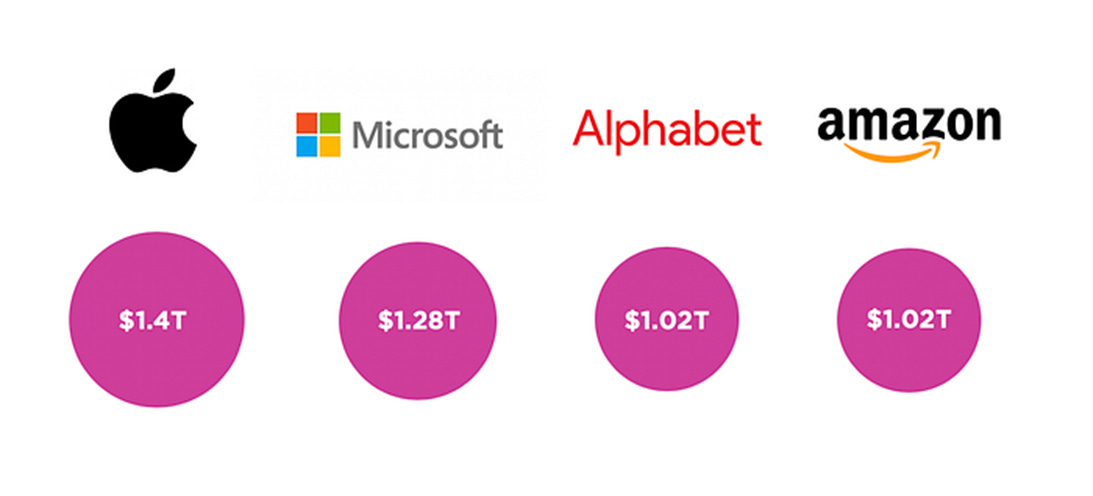
We, the people, have allowed ourselves to be dominated by oligarchs who have no interest, whatever, in our well-being. Four trillion dollar companies, Apple, Microsoft, Alphabet (that is, Google) and Amazon, control by their algorithms what we see, hear and presumably understand as we interact with the internet.1
An equally small number of giant companies lead the drive to universal AI: Nvidia, Microsoft, Google, Amazon, and Meta Platforms, each valued in the trillions of dollars.2
Open AI, the promotor of “Chat GPT, in a series of convoluted multi-billion dollar deals, is alone responsible for building a number of data center campuses.3 However, while it has accounted for over $1 trillion in AI infrastructure deals, it managed to lose some $11.5 billion in revenue over the last three months.4
In the last couple of days, Nobel Prize winner Geoffrey Hinton, known as “the godfather of AI,” spoke of AI’s impact on future employment during an interview on Bloomberg.5 Asked whether trillion dollar investments in AI could ever pay off without eviscerating the job market, Hinton said, “I believe it can’t” “I believe that to make money you’re going to have to replace human labor.”6
And, in fact layoffs due to AI are already happening in sectors across the economy. They include banking, the auto industry and even Walmart.7 Of the 159,000 layoffs reported at the end of October, fully 31,039 were caused by AI.8 By the way, in addition to destroying jobs formerly done by us humans, Open AI is busily destroying humans themselves. Open AI now faces at least seven law suits accusing its Chat GPT of actively assisting at least four people into committing suicide.9
Dependence on large companies can be costly, as we’ve just seen with the GMC Battery Plant’s construction suddenly uncertain. What once was touted to produce 1600 or more “good” jobs,10 now that plant, partially constructed, has likely turned some 650 acres of what had been agricultural land into our latest “brownfield.”11 Maybe in four or more years GMC’s plant might actually employ 1600 (hopefully human) workers -- if the economy does not in the meantime blow up in an AI - Crypto Currency bubble.
The oligarchs are definitely not our friends:
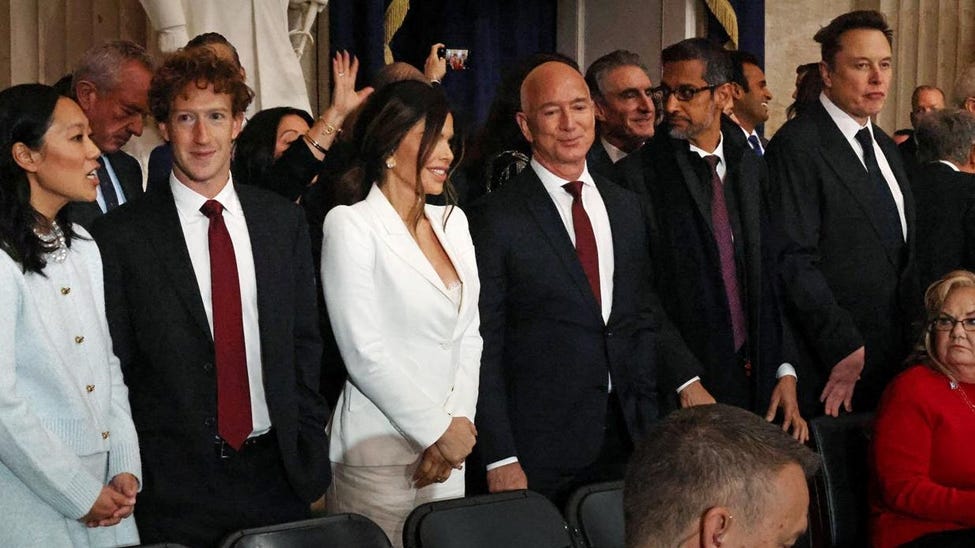
Priscilla Chan, Meta founder Mark Zuckerberg, Lauren Sanchez, Amazon founder Jeff Bezos, Google CEO Sundar Pichai and Tesla CEO Elon Musk at the inauguration ceremony. (Forbes (POOL/AFP via Getty Images).
Notes:
1. Medium, “The Algorithm of the World’s Most Successful Companies…and What That Means for Public Service Media,” (July 2, 2022), https://medium.com/shapes-ideas/the-algorithm-of-the-worlds-most-successful-companies-and-what-that-means-for-public-service-media-73955fa1a36e
2. “The AI market in 2025 is dominated by a select few companies that combine the top of human ingenuity with deep technological expertise. Leading the pack are Nvidia, Microsoft, Alphabet (Google), Amazon, and Meta Platforms, each valued in the trillions of dollars. These firms span multiple AI sectors, from hardware to cloud services to software platforms, reflecting AI’s broad application across industries and consumer “ markets.”
Statista, “Artificial intelligence (AI) market leaders - statistics & facts,” (September 11, 2025), https://www.statista.com/topics/13788/artificial-intelligence-ai-market-leaders/?srsltid=AfmBOooyieXQ_sUWNkahw8JQMQk7JXhVXgb9y8DOyhWch2yvr5QCYUXs#topicOverview
See also, Bloomberg NEF, “Power for AI: Easier Said Than Built,” https://about.bnef.com/insights/commodities/power-for-ai-easier-said-than-built/:
“Unlike fragmented markets such as electric vehicles or heat pumps, a handful of financially powerful tech companies dominate the data center industry. Four companies – Amazon Web Services (AWS), Google, Meta and Microsoft – currently control 42% of US data-center capacity. AWS alone has plans to quadruple its current 3-gigawatt capacity to nearly 12 gigawatts, indicating substantial influence over regional infrastructure.”
3. New York Times, “How Open AI Uses Complex and Circular Deals to Fuel Its Multibillion-Dollar Rise,” (October 31, 2025), https://www.nytimes.com/interactive/2025/10/31/technology/openai-fundraising-deals.html
4. Futurism, (November 6, 2025), “The AI industry Can’t Profit Unless It Replaces Human Jobs, Warns Man Who Helped Create It,” https://futurism.com/artificial-intelligence/ai-industry-geoffrey-hinton-automation
5. Bloomberg, “Wall Street Week: Nobel Prize Winner on AI ‘Existential Threat,’” https://www.bloomberg.com/news/videos/2024-10-25/wall-street-week-nobel-prize-winner-on-ai-threat-video
6. Futurism, “The AI Industry Can’t Profit Unless it Replaces Human Jobs, Warns Man Who Helped Create It,” (November, 6, 2025), https://futurism.com/artificial-intelligence/ai-industry-geoffrey-hinton-automation
7. CNBC, “AI is already taking white-collar jobs. Economists warn there’s ‘much more in the tank’” (October 22, 2025), https://www.cnbc.com/2025/10/22/ai-taking-white-collar-jobs-economists-warn-much-more-in-the-tank.html:
”JPMorgan Chase and Goldman Sachs are harnessing it to employ fewer people. Ford CEO Jim Farley warned that it will “replace literally half of all white-collar workers.” Salesforce’s Marc Benioff claimed it’s already doing up to 50% of the company’s workload. Walmart CEO Doug McMillon told The Wall Street Journal that it “is going to change literally every job.
The “it” that’s on corporate America’s lips is artificial intelligence.”
8. New York Post, “AI wreaks havoc on US jobs with two-decade high 150K cut in October – bringing 2025 total to 1M: report,” (November 6, 2025), https://nypost.com/2025/11/06/business/ai-wreaks-havoc-on-us-jobs-with-two-decade-high-150k-cut-in-october-report/#:~:text=Business-,AI%20wreaks%20havoc%20on%20US%20jobs%20with%20two%2Ddecade%20high,2025%20total%20to%201M:%20report&text=US%20employers%20axed%20about%20153%2C000,tasks%20once%20done%20by%20humans.&text=Companies%20cited%20artificial%20intelligence%20in,the%20firm’s%20chief%20revenue%20officer.
9. Wall Street Journal, “Seven Lawsuits Allege Open AI Encouraged Suicide and Harmful Delusions,” (November 6, 2025), https://www.wsj.com/tech/ai/seven-lawsuits-allege-openai-encouraged-suicide-and-harmful-delusions-25def1a3
See also, CNN Investigates, “‘You’re not rushing. You’re just ready:’ Parents say Chat GPT encouraged son to kill himself” (July 25, 2025),
https://www.cnn.com/2025/11/06/us/openai-chatgpt-suicide-lawsuit-invs-vis,
10. South Bend Tribune, “Updated: St. Joseph County approves deal in effort to reel in $2.5B Ultium battery plant,” (September 27, 2022), https://www.southbendtribune.com/story/news/2022/09/27/st-joseph-county-ready-to-make-offer-for-ultium-cells-plant/69520172007/?gnt-cfr=1&gca-cat=p&gca-uir=true&gca-epti=z11xx02d00----v11xx02b00xxxxd11xx65&gca-ft=159&gca-ds=sophi
11. GMAuthority (November 3, 2025), “Workers Laid Off As GM, Samsung SDI Indiana Battery Plant Construction Slows Down” https://gmauthority.com/blog/2025/11/workers-laid-off-as-gm-samsung-sdi-indiana-battery-plant-construction-slows-down/
“The Detroit News reports that General Motors and its partner, Samsung SDI, have halted construction of their $3.5 billion Indiana battery plant, resulting in the layoff of an undisclosed number of workers this month. The slowdown at the New Carlisle site signals a strategic recalibration for GM as the auto giant navigates a shifting landscape for electric vehicles.”
Thank you for your attention.
So ended the November 12 annotated submission to the Council.
This Battle, At Least, Won
Having lost twice, the mystery data center proponent went dark; it appeared to work the political backrooms. E.g., “5 top local officials write letter supporting data center proposals,” https://www.southbendtribune.com/story/news/2025/12/02/st-joseph-county-officials-write-letter-supporting-data-centers/87555562007/. Geratoni says he hired political consultant behind data center letter, https://www.southbend tribune.com/story/news/2025/12/05/what-we-know-about-data-center-letter-local-county-officials-signed/87588440007/.
The next Council meeting, crucial for the rezoning to be approved, occurred on December 9 - 10, 2025. The Council’s tape shows the proponent took up almost three hours to make its case, never once admitting who the actual principal was. Meanwhile, the Council chamber, the large room outside the chamber and the downstairs lobby was filled to capacity. A good number of union apprentices and filled several seats, but, by far, hundreds of opponents attended in person inside, outside and downstairs. So many attempted to attend by Zoom that that they blew past its capacity such that the Council adjourned for 15 minutes so its technocrat could expand the number of attendees the system could support.
After the proponent finished its presentation, at least 61 ordinary citizens, young and old presented their arguments against the rezoning, 3 minutes at a time. Once again, I gave the Council an annotated, supplemented version of my 3 minutes, this time a couple of days before the day of decision:
Data Centers and the Next 50 (Or Fewer) Years
Fifty years ago this night, 1975, at the age of 35, I had been practicing law in Los Angeles for seven years. I tell you this for scale. 50 years is substantially shorter than the average American’s life span.
What has 50 years to do with the current data center frenzy here in St. Joseph County? The answer: electricity. AI, the primary reason for the explosion of data centers (as well as crypto, the Cloud and Tik Tok) is not possible without a flood of electricity never seen on earth before this generation.1
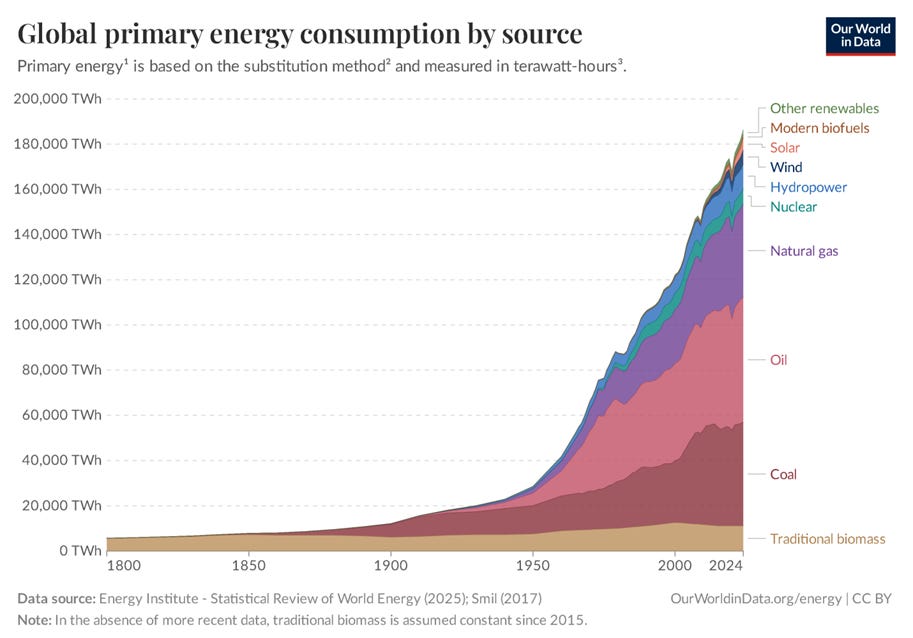
[Yes, this graph is a repeat of the one leading the first 3 minute annotated spiel in “Old Age: New Battles;” it can stand a second view.]
Electricity cannot exist without energy to produce it. Among possible sources of energy, solar and wind are minor players when it comes to operating the some 5,000 data centers we already have.2 The President having rejected the fact of global warming,3 the federal government intends, for at least the next three years, to suppress solar and wind power, as well as high density advanced batteries.4
Natural gas is now, and will be, the primary source of energy to power data centers world-wide.5 This is where the period of 50 years becomes relevant. According to Google’s AI, the world has only 50 years left before we run out of natural gas.6 When asked whether the drive to build data centers will have any effect on what remains of natural gas, Google’s AI answered:
“The global construction of data centers will likely accelerate the depletion of natural gas reserves, potentially shortening the 50-year extraction prediction. This is due to the enormous and rapidly increasing energy demands of AI and data centers, for which natural gas is a primary and immediate power source.”7
As the world’s nations grab the last cubic feet of natural gas to be found, economic -- and no doubt political -- pressures and disputes will intensify in ways we cannot imagine. At that point -- at most a couple of decades hereafter -- we and the world will face the ultimate question: who gets the last natural gas; and for how much treasure and blood?
These data centers are little more than self-indulgent toys of morbidly wealthy “tech bros;” oligarchs who have not a scintilla of interest or concern for the rest of us. They are throwing their wealth at a short term, final blow-out of power, on the hope that nuclear or fusion will save them in substantially less than 50 years. Fusion, however, as an actual source of energy, does not yet exist.8 In order for nuclear power to replace natural gas would require better than 400 entirely new plants.9 And finally, a reminder: Three Mile Island’s melt-down happened a mere 46 years ago, in 1979.10
Notes:
1. Our World in Data, “Global Primary Energy Consumption by Source,” https://ourworldindata.org/grapher/global-primary-energy .
2. According to Google’s AI, on December 5, 2025,
“As of November 2025, there are an estimated over 5,000 data centers in the United States, making it the country with the most data centers worldwide. Specific estimates vary by source, ranging from approximately 4,165 to 5,427 facilities.”
See, National Telecommunications and Information Administration, “NTIA Seeks Comments on Supporting U.S. Data Center Growth,” (September 4, 2024), https://www.ntia.gov/press-release/2024/ntia-seeks-comments-supporting-us-data-center-growth#:~:text=Data%20centers%20are%20facilities%20with,by%209%25%20annually%20through%202030
3. ABC News, “Fact-checking what Trump said about climate change during the UN General Assembly” (September 23, 2025), https://abcnews.go.com/Politics/fact-checking-trump-climate-change-general-assembly/story?id=125855451
4. Reuters, “Trump removes ‘renewable’ from title of U.S. energy lab,” (December 2, 2025), https://www.reuters.com/business/energy/trump-removes-renewable-title-us-energy-lab-2025-12-02/
Politico, E&E News, “How Trump’s ‘big, beautiful bill’ hits wind, solar and batteries,” https://www.eenews.net/articles/how-trumps-big-beautiful-bill-hits-wind-solar-and-batteries/
5. MIT Technology Review, “AI Could Keep Us Dependent on Natural Gas for Decades to Come,” (May 20, 2025), https://www.technologyreview.com/2025/05/20/1116272/ai-natural-gas-data-centers-energy-power-plants/
Oil Price.com, “Data Centers, AI, and Energy: Everything You Need to Know,” (Nov 25, 2025). https://oilprice.com/Energy/Energy-General/Data-Centers-AI-and-Energy-Everything-You-Need-to-know.html#:~:text=Over%20the%20last%20five%20years,2%20percent%20of%20global%20demand
6. Stanford University, “When Fossil Fuels Run Out, What Then?” (May 23, 2019), https://mahb.stanford.edu/library-item/fossil-fuels-run/
MET Group, “When Will Fossil Fuels Run Out?” (January 21, 2022), https://group.met.com/en/mind-the-fyouture/mindthefyouture/when-will-fossil-fuels-run-out/
ZME Science, “How long before the world runs out of fossil fuels?” (April 28, 2024), https://www.zmescience.com/feature-post/how-long-fossil-fuels-last-43432/
7. Asked of Google on November 29, 2025,
“What impact will the current construction of data centers across the world have on the prediction that extraction of natural gas will last for 50 years from the present?”
Google answered,
“The global construction of data centers will likely accelerate the depletion of natural gas reserves, potentially shortening the 50-year extraction prediction. This is due to the enormous and rapidly increasing energy demands of AI and data centers, for which natural gas is a primary and immediate power source.”
Natural gas is not the only fossil fuel necessary to hyperscale data center operations. Asked of Google on December 6, 2025,
“To what extent are hyperscale data centers dependent on diesel powered generators?”
Google answered:
“Hyperscale data centers are highly dependent on diesel-powered generators, which are currently the industry standard for reliable, continuous backup power during grid outages. This dependency is driven by the critical need for constant uptime (often aiming for “seven nines” or 99.99999% availability) to prevent massive data loss and financial impact.”
At the present time, before the data center binge has reached its apogee, up to 290 CO2-spewing diesel generators service each of the more than 5,000 existing data centers we have in the United States. McKinsey & Co., “Scaling bigger, faster, cheaper data centers with smarter designs,” (August 1, 2025), https://www.mckinsey.com/industries/private-capital/our-insights/scaling-bigger-faster-cheaper-data-centers-with-smarter-designs. In the course of its lengthy report, McKinsey said this of the need for diesel generators:
“For instance, the diesel generators used for large-scale data centers are commonly 3.5 to 4.0 MW per unit . . . . Scaling this approach to a one-GW data center [the kind we’re talking about here] would require up to 290 generators, and all of them would need to be maintained and prepared for a power loss situation . . . .”
So, the next question to be asked is obvious: how much oil do we have left?
Asked of Google on November 25, 2025,
“Assuming consumption of oil will increase over time to reach 113 million barrels per day by 2050 how soon from the present day will the world run out of recoverable oil?”
This was its AI’s answer:
“Assuming oil consumption rises to 113 million barrels per day by 2050, and with known reserves estimated at about 1.65 trillion barrels, the world would run out of recoverable oil in approximately 30 to 33 years from 2025, or around 2055 to 2058. However, estimates vary significantly and many sources indicate that known reserves will last for around 47-56 years at current consumption rates, suggesting that the 2050 scenario could lead to a much sooner depletion.”
8. Fortune, “Nuclear Fusion, the ‘Holy Grail’ of Power, Was Always 30 Years Away -- Now it’s a Matter of When, Not If, Fusion Comes Online to Power AI,” (October 2, 2025) https://fortune.com/2025/10/02/nuclear-fusion-online-commercial-ai-power/
Fortune, “Nuclear Fusion is the Tech That Could Power AI and Save the Planet -- If It Ever Works,” (May 7, 2025), https://fortune.com/2025/05/07/nuclear-fusion-energy-ai-sam-altman-helion-pacific-commonwealth-timelines/
9. Asked of Google on November 30, 2025,
“How many nuclear and/or fusion power plants will be necessary to replace natural gas as a source of electricity in the U.S.?”
This was Google’s answer:
“To replace the electricity currently generated by natural gas in the U.S. using conventional nuclear technology, approximately 400 to 450 new nuclear reactors would be necessary, in addition to the existing fleet.”
and,
“Commercial fusion power plants do not exist yet, though research is ongoing and some experts project demonstration within the next 10-20 years. Therefore, current projections for large-scale energy replacement rely on existing fission technology.”
10. Wikipedia, “Three Mile Island Accident,” https://en.wikipedia.org/wiki/Three_Mile_Island_accident
Thank you for your attention
P.S.: As we continue to burn fossil fuels, atmospheric CO2 continues to rise, unabated, as this latest graph from NOAA as of January, 2025 (updated from the original message to the Council) demonstrates:
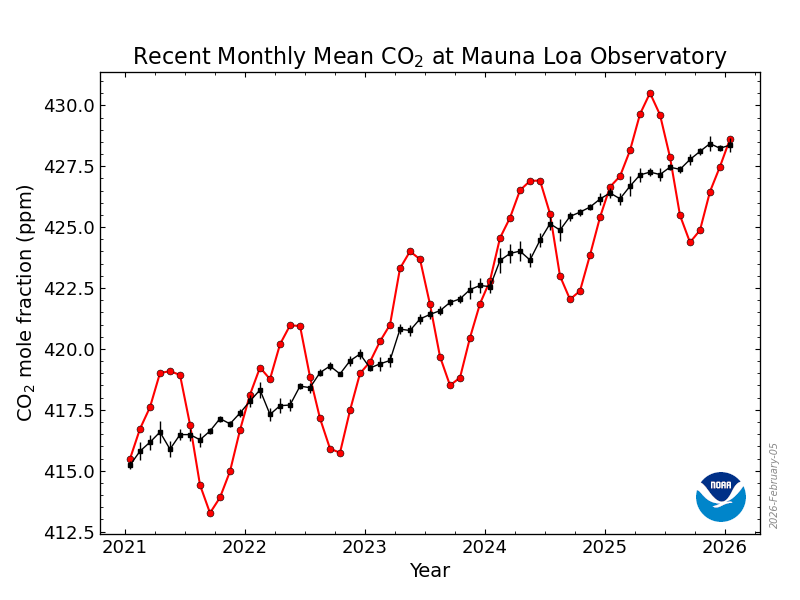
As noted earlier, the last time Earth experienced this level of CO2 in its atmosphere was at least 14 million years ago. Columbia Climate School, “A New 66 Million-Year History of Carbon Dioxide Offers Little Comfort for Today,” (December 7, 2023), https://news.climate.columbia.edu/2023/12/07/a-new-66-million-year-history-of-carbon-dioxide-offers-little-comfort-for-today/
In that connection, you might read this new book: Ian McEwan, “What We Can Know.” The plot: in 2119 a couple of academics, working in a changed Britain, attempt to reconstruct a famous dinner party that had happened more than 100 years ago, back in 2014.
So, What Happened?
At some point after 4:00 a.m., Wednesday, December 10, the session having lasted some 9 1/2 hours from its start, the Council rejected the proposed rezoning, by a bipartisan vote of 7 to 2. At long last, the people won this battle against a giant cloaked in darkness. But the fight is not over. Rumor has it that a (perhaps the) proponent intends to put a hyperscale data center ‘campus” on some 300 acres within the City of South Bend’s limits. “Potential data center in South Bend raises concerns for council member,” https://www.southbendtribune.com/story/ news/local/2025/12/18/western-hospitality-partners-proposes-data-center-in-south-bend/87817465007/.
Nicely done, John. And you are right, the oligarchs are not our friends!
Did you get the chance to listen to the NYT "The Daily" podcast on 2/16? They summarized the potential of the power of people to show up to "windowless rooms" to make a difference. You have been going to county meetings for sometime, so you know!